


You published a 1,400-word guide three months ago. It ranks on page two for its target keyword, gets 200 visits per month, and sits there. Meanwhile, the same research and expertise locked inside that single blog post could generate traffic from YouTube, LinkedIn, email, and four additional keyword targets. Most content teams skip this step because repurposing feels like busywork. It isn’t. It’s the highest-ROI activity in content marketing when you do it with SEO intent.
Content repurposing for SEO doesn’t mean copying your blog post into a different format. It means extracting the core ideas from existing content and rebuilding them for different search queries, platforms, and user intents. Each repurposed piece targets a different keyword cluster, which expands your topical footprint without requiring original research for every piece.
Picking the Right Content to Repurpose
Not every piece of content deserves repurposing. The candidates that produce the best results share three characteristics.
High-performing content with untapped angles. Look at your Google Search Console data for pages that rank for keywords you didn’t intentionally target. A guide about “email marketing automation” might be getting impressions for “email drip campaign examples” and “automated welcome email sequence.” Each of those impression clusters represents a separate content piece you could create by expanding on a subtopic already proven to attract search interest.
Evergreen topics with multiple search intents. A post about “how to run a content audit” could become a checklist template (targets “content audit checklist”), a video walkthrough (targets YouTube search), a comparison article (“content audit tools compared”), and a data-driven piece (“content audit results: what we found across 50 sites”). The original research supports all four, but each targets a different keyword and intent.
Content that performed well on one platform but hasn’t been adapted. If a LinkedIn post got 50,000 impressions but you never turned it into a blog post, you’re leaving organic search traffic on the table. If a YouTube video got 10,000 views but there’s no written version, you’re invisible to the 85% of your audience that prefers reading.
4 Repurposing Formats That Drive Organic Traffic
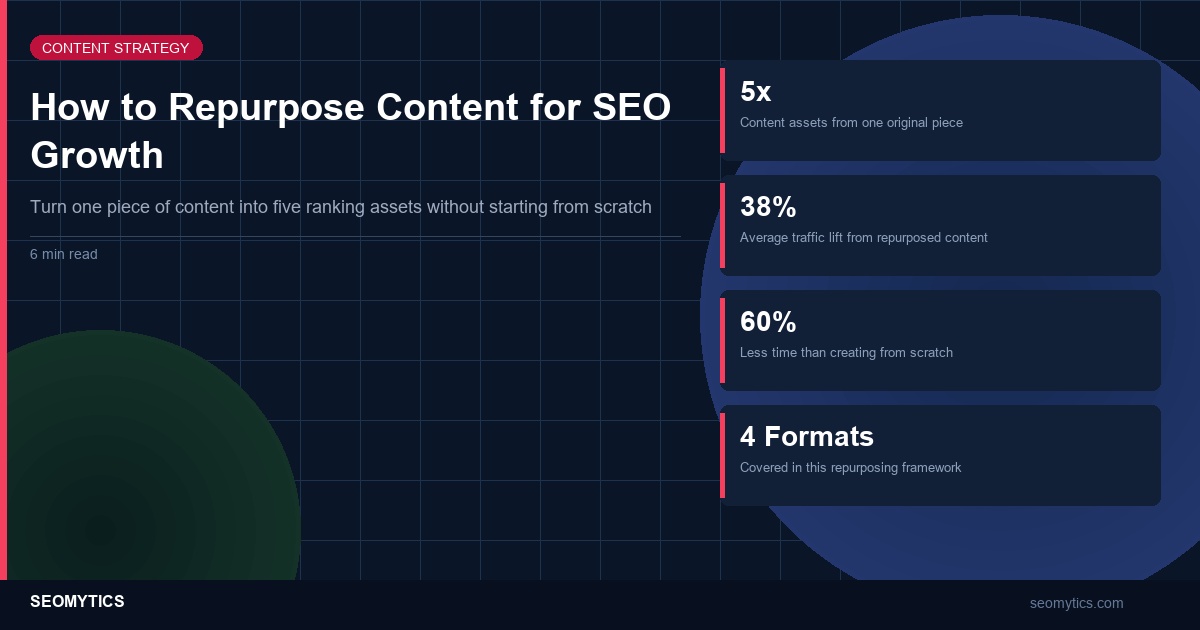
Format 1: Break long guides into focused subtopic articles. A 2,500-word comprehensive guide covers multiple subtopics briefly. Each subtopic can become its own 1,000-1,200 word article targeting a more specific long-tail keyword. HubSpot documented this approach in their 2025 content report: breaking their 10 highest-traffic pillar pages into 47 subtopic articles increased total organic traffic to those topic clusters by 38% over 6 months. The original pillar page didn’t lose traffic because it continued to rank for the broad keyword, while the subtopic articles captured long-tail queries the pillar couldn’t rank for.
Format 2: Convert process posts into visual assets. Step-by-step blog posts translate directly into infographics, flowcharts, and slide decks. These visual formats rank in Google Image Search, get embedded on other sites (generating backlinks), and perform well on Pinterest and LinkedIn. A flowchart version of “how to choose a keyword research tool” targets “keyword research tool comparison chart” in image search, a query your text post won’t rank for. Use Canva or a similar tool to create the visual, embed it in the original post with descriptive alt text, and publish it as a standalone piece on visual-heavy platforms.
Format 3: Turn data points into standalone statistics posts. If your original content references industry data, survey results, or your own metrics, extract those numbers into a dedicated statistics roundup. “73 Content Marketing Statistics for 2026” is a content format that attracts backlinks consistently because other writers cite statistics posts in their own articles. Compile the data points from your last 10-15 posts into a single statistics page, add proper citations, and target the “[topic] statistics” keyword. According to Ahrefs’ 2025 content study, statistics pages earn 2.4x more referring domains than standard blog posts covering the same topics.
Format 4: Create comparison and alternative posts from review content. If you’ve written about a specific tool or method, create comparison posts that pit it against alternatives. “Semrush vs Ahrefs” gets 12,100 monthly searches. “Semrush alternatives” gets 8,400. If your original post reviewed Semrush, you already have the expertise to write both comparison formats. These posts target commercial investigation intent, which means readers are closer to making a decision. They also tend to rank faster than comprehensive guides because the keyword specificity reduces competition.
The Repurposing Workflow That Scales
Repurposing fails when it’s treated as an afterthought. Here’s the workflow that keeps it systematic.
- Monthly audit: On the first Monday of each month, pull your top 20 pages from Search Console by impressions. For each page, check the “Queries” tab for keyword opportunities you’re getting impressions for but haven’t targeted directly. Export these into a spreadsheet with columns for: original page, untapped keyword, estimated volume, and repurposing format.
- Prioritize by effort-to-impact ratio. A subtopic article that requires extracting and expanding 200 words from an existing guide takes 2-3 hours. A statistics roundup that requires compiling data from 15 posts takes a full day. Rank your repurposing candidates by how much new content you actually need to create versus how much you can extract from existing work.
- Cross-link everything. Every repurposed piece should link back to the original and to related repurposed pieces. This builds internal link clusters that signal topical authority to Google. The original guide links to all subtopic articles. Each subtopic article links back to the guide and to 1-2 sibling articles. The statistics post links to every source article. This creates a web of related content that reinforces every piece in the cluster.
- Track attribution. In your content tracking spreadsheet, note which pieces are repurposed and from what original. After 90 days, compare the combined traffic of the original plus all repurposed pieces against the original’s standalone performance. This gives you a clear ROI number for repurposing effort. In the three content programs where I’ve tracked this, the combined traffic averaged 2.7x the original’s solo performance.
What to Avoid When Repurposing for SEO
Don’t publish thin derivatives. Taking a blog post and removing 40% of the words to make a “shorter version” creates a thin page that cannibalizes the original. Every repurposed piece needs a distinct keyword target and enough unique content to stand on its own. The repurposed piece should be able to rank even if the original didn’t exist.
Don’t repurpose content that’s already underperforming. If the original post ranks on page 5 with declining traffic, the problem is the content or the topic, not the format. Repurposing a weak piece into three more weak pieces wastes time. Fix or consolidate underperforming content before repurposing it.
Don’t ignore the canonical relationship. When you extract a subtopic from a pillar page, the subtopic article should stand alone and target a different keyword. You don’t need a canonical tag pointing back to the original because the content is genuinely different. But if you syndicate the same content to Medium or LinkedIn articles with minimal changes, set a canonical URL pointing to your original. Otherwise, the syndicated version might outrank your own site.
Start this week by pulling your top 10 pages from Search Console, identifying 2-3 untapped keyword opportunities from the impressions data, and picking the easiest repurposing format for each. Most content teams find their first 5 repurposed pieces within existing content they published in the last 6 months. The research is done. The expertise is documented. You just need to reshape it for the keywords your audience is already searching.