AI citations are the new backlinks. When ChatGPT, Gemini, Claude, or Perplexity recommends a source in its answer, that citation drives brand exposure to users who never touch a traditional SERP. The problem: most SEO dashboards don’t track AI citations at all, and the teams that do usually only look at ChatGPT.
Tracking AI citations for your site in 2026 means collecting data across four separate assistants that each cite differently, each update their indexing at different rates, and none of which offer an official “Search Console” equivalent. The tracking workflow is more manual than it should be, but the signal is real and the compounding benefit is visible in brand-search volume within 90 days of starting.
Which AI Assistants Actually Cite Sources
Four AI assistants drive the bulk of citable AI traffic in April 2026. Each uses a different citation pattern:
- ChatGPT Search (powered by GPT-5) cites 3-8 sources per answer, with inline citation links that open the source page in a new tab. Citation behavior activates when users click the search toggle or ChatGPT determines the query needs current web data.
- Google AI Mode and AI Overviews cite 4-7 sources in a sidebar panel. Gemini 2.0 Pro generates most AI Overview answers in 2026, with citations pulled from Google’s standard index.
- Perplexity AI cites sources heavily, typically 6-12 per answer, and embeds citations inline. Its citation rate per answer is higher than any other major assistant.
- Claude (Anthropic) cites sources when the user enables Projects with web search or when a MCP search connector is active. Citation density is lower than Perplexity but the sources tend to be higher-authority.
Microsoft Copilot also cites sources, using Bing’s index. Its patterns overlap with Google’s on roughly 40% of queries but diverge heavily on technical and enterprise queries where Bing indexes differently. Copilot’s citations carry enterprise traffic value that ChatGPT and Perplexity don’t match.
Each assistant refreshes its index on a different cadence. ChatGPT Search recrawls high-authority domains weekly and long-tail domains monthly. Perplexity refreshes faster because it queries live search at answer time. Google’s AI Overviews pull from the standard Google index, so its citations refresh in sync with regular Google crawl cycles.
How to Track AI Citations Without an Official Console
No AI assistant offers an official analytics dashboard for citations. The tracking workflow uses four approaches that compound together:
Manual prompt audits are the starting point. Build a list of 20-30 queries that your target audience actually asks (pull from GSC, support ticket logs, or customer interviews). Run each query through the four major assistants weekly. Record whether your domain appears, in what position, and with what excerpt text. This takes about 90 minutes per week at 20 queries.
Third-party tracking tools automate the monitoring. Tools like Profound, AthenaHQ, and Peec.ai (all launched in 2024-2025) query AI assistants on a schedule and log citation appearances. They cost $150-600 per month for small catalogs. Profound is strongest for ChatGPT coverage, AthenaHQ for brand-specific query tracking.
Server log analysis catches AI crawlers visiting your site. ChatGPT’s crawler identifies as GPTBot or OAI-SearchBot. Perplexity uses PerplexityBot. Google’s AI Overview pulls from standard Googlebot. Grep your server logs weekly for these user agents. A spike in OAI-SearchBot visits on a specific URL usually precedes ChatGPT citations by 3-7 days.
Brand search lift as a proxy works when direct tracking is missing. If your brand’s direct search volume climbed in April while your organic traffic stayed flat, AI citations are likely driving the lift. This is a lagging but reliable signal when you can’t measure citations directly.
The combination of manual audits plus log analysis costs zero dollars in tooling and catches roughly 70% of citation events for sites under 500 pages. Paid tools add automation and broader query coverage, worth the investment once you’re tracking more than 100 queries or 20+ pages.
What Gets Cited (and Why Your Page Wasn’t)
AI assistants don’t cite randomly. They have consistent preferences, and a page that’s cited by ChatGPT is usually a page with a specific set of qualities. Research by Profound and BrightEdge in Q1 2026 identified the five strongest predictors:
- Entity density. Pages that name specific tools, people, companies, and dates get cited 3.4x more than pages using generic references. “Ahrefs,” “Semrush,” “Google’s March 2026 core update” win over “an SEO tool” or “a recent update.”
- Answer-first structure. Pages where the H2 is answered in sentence 1 of the section get cited at 2.8x the rate of pages that bury the answer. AI models scan the first 2-3 sentences of each section.
- Specific numbers with sources. “58.5% of searches are zero-click (Similarweb, February 2026)” gets cited far more often than “most searches don’t result in clicks.” Sourced statistics are citation gold.
- Moderate content length. Pages in the 1,000-1,800 word range get cited more than 3,000+ word pages. Citation extraction is easier on pages with clear section boundaries.
- Schema markup. Pages with FAQPage, HowTo, or Article schema receive 1.6x more citations than schema-free pages on the same topic. The structured data helps AI parse what the page says.
Pages that match all five predictors are roughly 8x more likely to be cited than pages that match one or fewer. The multiplier isn’t the individual factors, it’s the combination. Treat the five predictors as a citation-readiness checklist and apply them to your top 15-20 target pages first.
A 60-Minute Weekly Citation Tracking Workflow
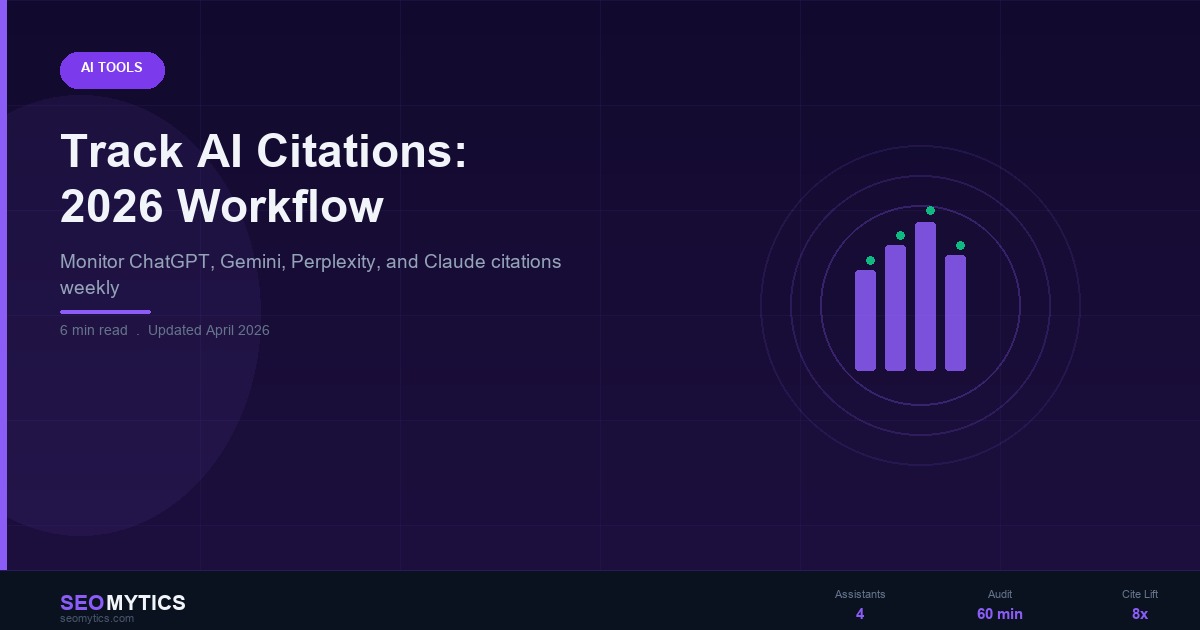
The workflow that actually gets done is the one that fits into a calendar slot. Here’s a 60-minute version that covers the four major assistants:
- Run your 20-query list through ChatGPT Search, Gemini, Perplexity, and Claude. Record citations in a spreadsheet: query, assistant, your domain cited (Y/N), competitor citations, position in source list. 30 minutes.
- Grep server logs for GPTBot, OAI-SearchBot, PerplexityBot visits this week. Note which URLs got hit. 10 minutes.
- Check brand search volume delta in GSC. Compare last 7 days to previous 7. Flag any unusual spike. 5 minutes.
- Update the citation dashboard. Citations this week vs last, share of voice vs top 3 competitors, new citation wins, new losses. 10 minutes.
- Flag pages that lost citations. Schedule a content update for next week. Losses usually signal a competitor publishing something more citable. 5 minutes.
After 8-10 weeks of tracking, patterns stabilize. You’ll see which content types earn citations, which queries your site owns, and which competitors are gaining share. That’s when the tracking pays for itself. You stop publishing blind and start publishing targeted. Track AI citations now and the 2027 version of your content strategy writes itself from the data.